

Key takeaways
Human factors training helps you understand how people, systems, and environments interact to improve safety performance and reduce error.
It builds stronger decision-making, communication, and investigation skills and creates a more resilient, learning-focused safety culture. Start with a pilot training programme and measure impact through behaviour change, fewer repeat incidents, and improved reporting quality.
What is human factors training
Human factors training helps you understand how people interact with their work environment, equipment, and procedures, enabling you to design safer, more efficient systems. It draws on psychology, engineering, and ergonomics. Ergonomics means designing tasks and tools so they fit the body and how people work in practice.
Human factors originated in ergonomics research and in aviation and industrial safety studies during and after the Second World War. Today, you apply it across healthcare, manufacturing, energy, and transport. Training teaches how attention, memory, decision-making, fatigue, communication, and organisational culture influence performance and risk.
The goal is simple. You reduce error by designing systems that anticipate human variability and absorb mistakes. Training outcomes include stronger safety culture, better incident investigations, and measurable reductions in repeat events.
Why human factors training matters for safety professionals
Human factors training shifts your focus from blaming individuals to strengthening the system's defences that prevent errors from becoming incidents. You learn to spot factors that influence performance, such as workload, poor interface design, and unclear procedures.
That knowledge improves investigation quality by revealing latent causes and producing system-level recommendations rather than quick fixes. It also supports a Just Culture, meaning an environment where people report problems without fear and where learning replaces punishment, and it helps provide regulators with clearer evidence of knowledge and control.
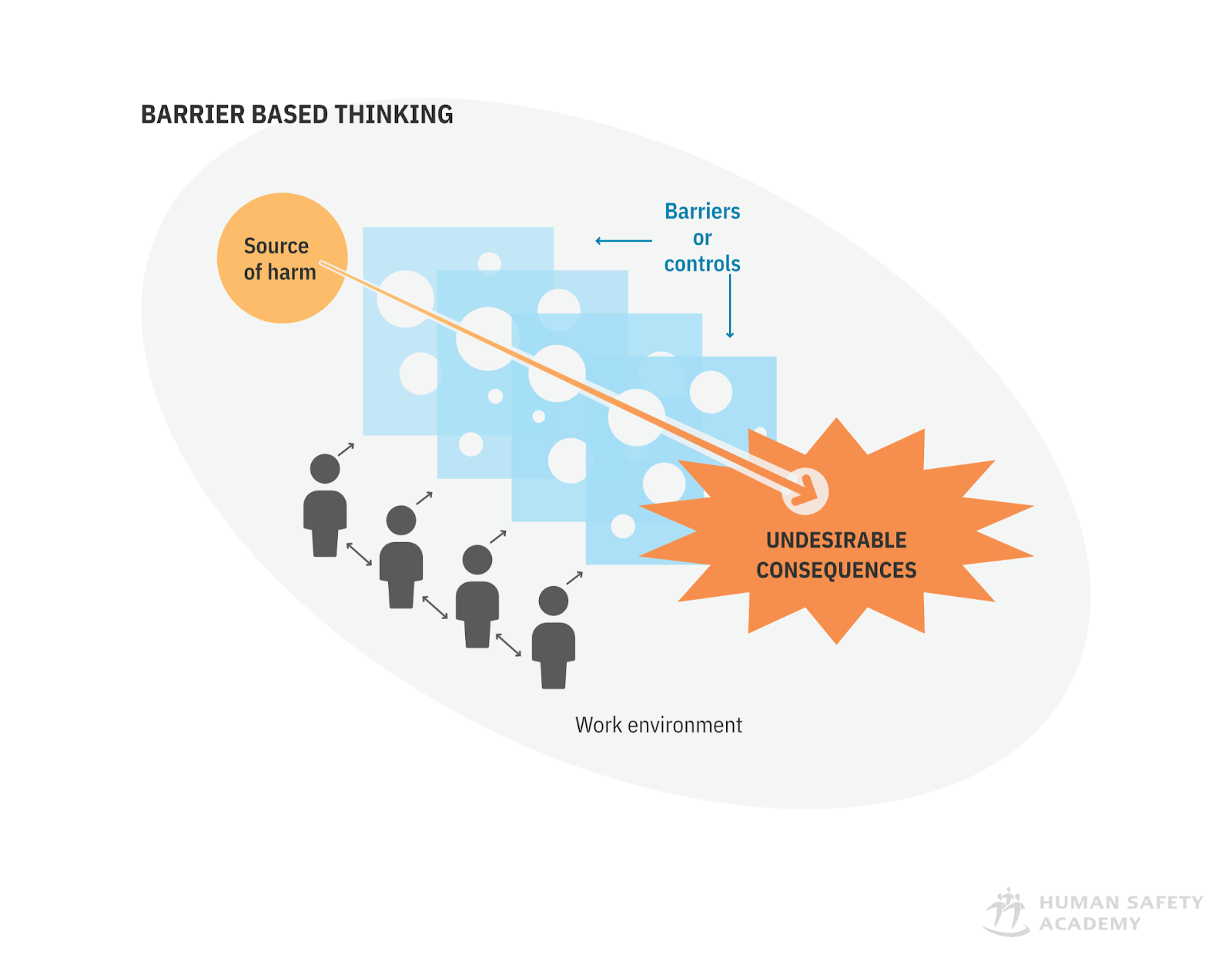
One way to visualise how risks pass through an organisation is through barrier-based thinking, which shows how multiple defences interact to prevent or allow an incident.
The three core domains of human factors in safety management
Human factors training gives you a structured way to analyse how people, tools, and organisations interact under real work conditions. The approach rests on three domains that together explain why errors happen and how you can reduce them.
Physical ergonomics examines how the body fits the task and the workplace. Poor layout, heavy repetitive lifting, and awkward control placement increase musculoskeletal risk and reduce reliability. You can start with simple task observations to spot obvious redesign wins.
Cognitive ergonomics encompasses mental processes such as perception, memory, and decision-making. Training in situational awareness, workload management, and stress handling improves non-technical skills. Use scenario practice to reveal where cognitive overload occurs.
Organisational factors consider the system around people: policies, supervision, resourcing, and culture. These latent conditions shape frontline behaviour and create persistent failure modes. Treat these factors as design problems that management can change rather than as individual shortcomings.
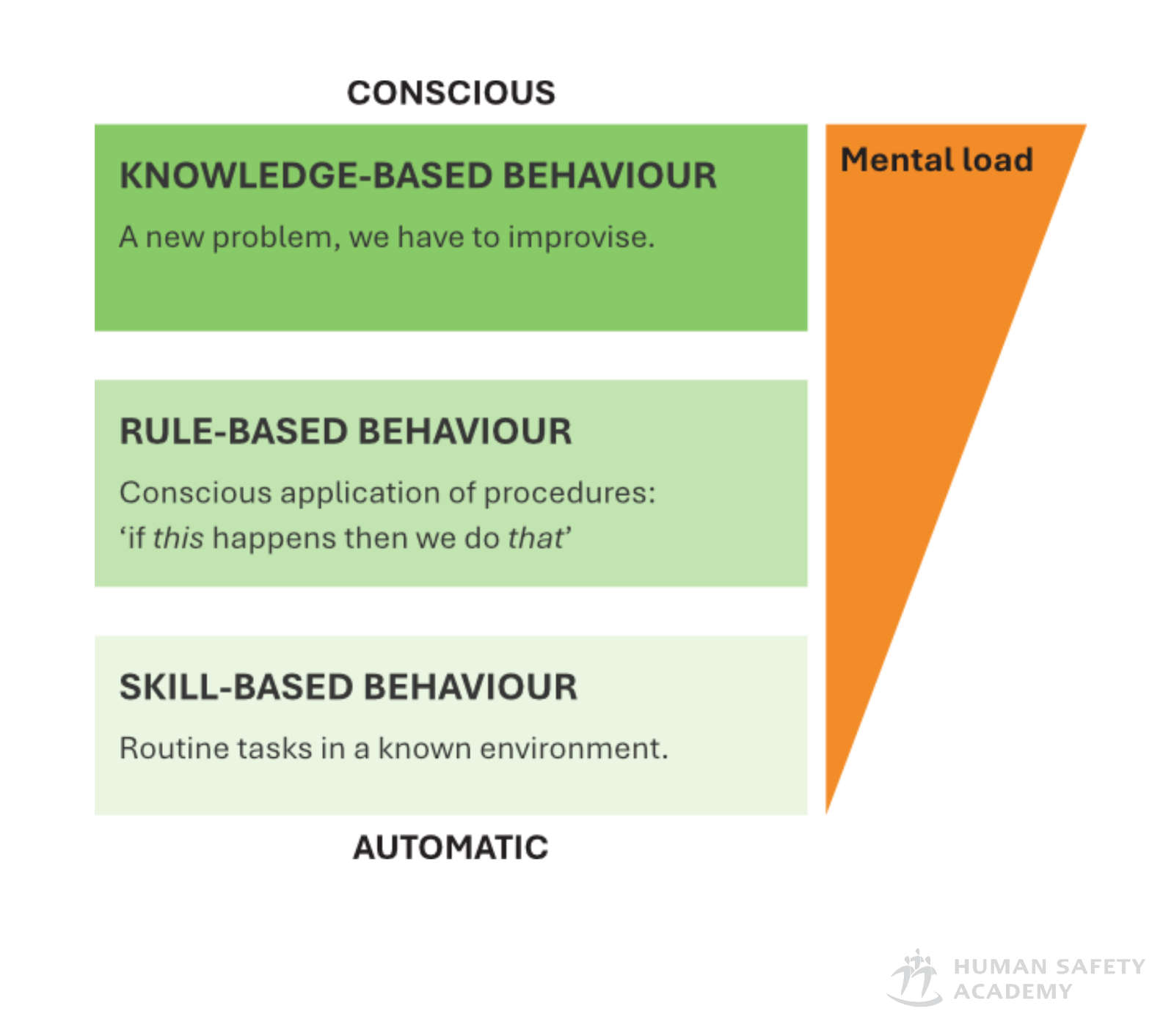
Human performance varies depending on the level of mental processing required for a task. In practice, people shift between automatic, rule-based and reasoning-based behaviour, each with different implications for workload and potential error.
The strategic benefits of human factors
Human factors training delivers measurable improvements across safety management. It strengthens your ability to investigate incidents, manage risk, and sustain performance under pressure.
When you apply human factors methods, investigations focus on the latent conditions that made errors likely. Organisations that integrate human factors training often report fewer repeat incidents and more effective corrective actions.
Training also improves proactive risk management. You learn to recognise performance-influencing factors before they become failures.
It supports compliance with recognised standards such as ISO 31000 (risk management) and ISO 45001 (occupational health and safety), as well as sector rules, including the EU Common Safety Method for Risk Evaluation and Assessment (CSM-RA) and the Dutch Working Conditions Act (Arbowet).
The result includes stronger audit evidence, improved workforce trust, and a demonstrable return on investment through fewer disruptions and safer operations.
Improving incident investigation with human factors analysis
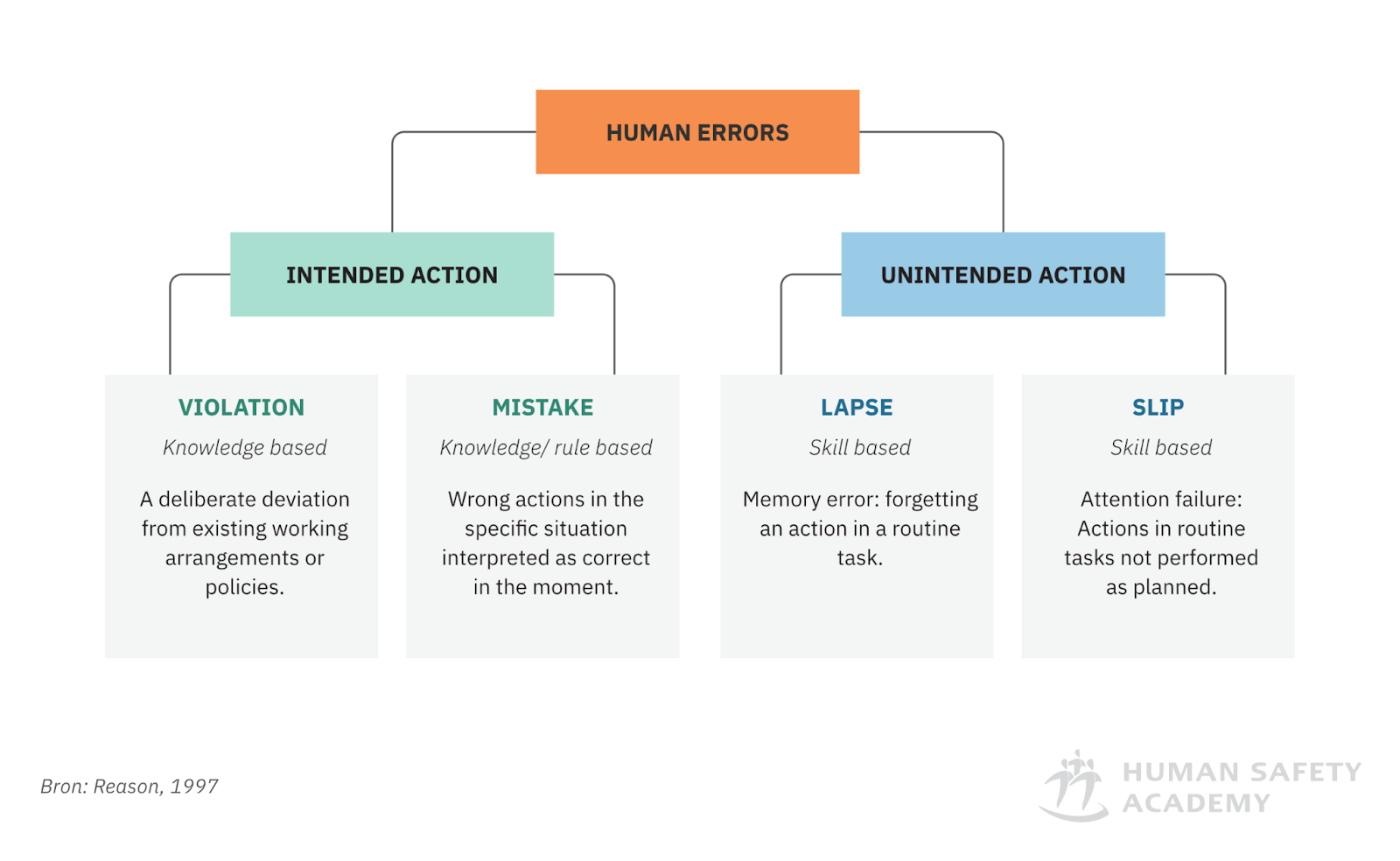
Human factors training equips you to investigate incidents in a structured and fair manner. It helps you identify not only what happened but why it made sense for people to act as they did at the time. To support this understanding, human factors distinguishes broadly between types of actions, helping investigators see whether an issue arose during execution or decision-making.
Use barrier-based methods, such as Tripod Beta, which maps error pathways, and Barrier Failure Analysis, which examines how controls failed, to trace the route from immediate errors to organisational weaknesses. These tools reveal performance-influencing factors such as fatigue, communication breakdowns, and poor interface design.
When you apply human factors analysis, investigations produce evidence-based insights rather than opinions. The outcome is clearer root-cause identification, stronger corrective actions, and a learning culture that reduces the likelihood of repeat incidents.
Proactive risk management through human factors integration
Human factors training helps you move from reactive investigation to proactive risk control. By integrating human performance data into tools such as BowTie analysis and Safety Management Systems (SMS), you can identify fragile barriers before incidents occur.
BowTie analysis is a visual method that links possible threats to a central hazardous event and maps the barriers that prevent escalation. When mapping a BowTie diagram, include human barriers, such as procedure use, supervision, and workload management, alongside technical ones. If training or staffing gaps make these barriers fragile, treat them as high-priority controls.
This proactive approach turns insight into prevention. You learn to strengthen human and organisational barriers early, reducing the likelihood of operational failures and improving overall resilience.
Integrating human factors with core safety methodologies
Human factors thinking strengthens the tools you already use to manage safety. When you build it into frameworks such as Safety Management Systems (SMS), BowTie analysis, and root cause methods, each tool gives a clearer picture of system performance.
Traditional Root Cause Analysis (RCA) identifies what failed. Human factors integration explains why it failed in the context of human capability, workload, or organisational pressure. The two approaches complement each other: RCA gives the sequence, and human factors add understanding.
To embed this thinking, start with small steps. Review your SMS pillars and add a human performance check under each one. In BowTie diagrams, mark where human barriers sit and evaluate their reliability alongside technical ones. These adjustments keep human performance visible and measurable in your routine safety work.
Enhancing safety management systems with human factors
Human factors principles make every pillar of a Safety Management System (SMS) more practical and effective. They ensure that safety processes work in practice, not only on paper.
In Policy, include commitments to a Just Culture and to improving human performance. In Risk Management, analyse performance-influencing factors, such as fatigue, workload, and task design, alongside technical risks. For Assurance, track metrics such as near-miss reporting and behavioural observations to verify learning and control effectiveness. Under Promotion, use training, coaching, and leadership briefings to reinforce system thinking.
These small integrations make your SMS more dynamic. They link what people experience day to day with what management monitors and measures.
Strengthening barrier-based models, such as BowTie analysis
Human factors training helps you see how people affect the strength and reliability of each barrier in a BowTie diagram. When you map threats and controls, include human performance as part of the barrier design, not as a separate issue.
For example, a procedure only works if the conditions for its use are met. If workload, communication, or interface design makes tasks harder to follow, the barrier weakens. By identifying these factors, you can reinforce the barrier with practical improvements such as task redesign, clearer prompts, and better supervision.
This approach maintains the realism of the BowTie model. It reminds you that every control depends on both technology and human reliability and that both need equal attention.
Implementing human factors training: methods, metrics, and return on investment
Effective human factors training blends classroom learning with applied practice so you practise the skills in real work settings. You learn theory and how to recognise human performance issues in day-to-day operations.
Practical delivery methods include interactive workshops, task simulations, and coaching sessions based on actual incidents. Virtual Reality (VR) and scenario-based learning create safe spaces to test decision-making under pressure. Blended learning through e-modules supports long-term reinforcement and scalability across large organisations.
To evaluate results, track both behaviour and outcomes. Use metrics such as error trend reduction, near-miss reporting rates, and time to close corrective actions. Apply established evaluation models, such as the Kirkpatrick model, to measure knowledge retention, behavioural change, and organisational results.
Typical returns on investment come from fewer repeat incidents, reduced downtime, and better regulatory compliance. The biggest gain is cultural: a workforce that understands how to manage human performance risk every day. Start small with a pilot cohort and capture baseline data before training so you can show measurable improvement and build leadership confidence.
Key metrics for evaluating human factors training effectiveness
To confirm that training delivers real-world impact, measure both learning outcomes and operational improvements. Use a mix of behavioural and system-level indicators for a complete view.
Knowledge and skill retention
Use post-course quizzes or scenario tests to verify understanding of key human factors principles. Run refresher assessments every six to 12 months to confirm sustained knowledge.
Behavioural change
Observe the application of human factors methods during investigations, briefings, or safety meetings. Look for improved communication, situational awareness, and decision-making in simulated or real operations.
Safety performance indicators
Track increases in near-miss and hazard reporting rates, which indicate better awareness and trust. Measure reductions in repeat incidents that involve the same performance-influencing factors. Monitor shorter time-to-close for corrective actions after investigations.
Organisational impact
Review safety culture survey results or Just Culture indicators. Use simulation or role-based assessments to track competency improvements. Where possible, demonstrate links between training and lower incident frequency or claim costs.
Use these metrics consistently. They provide clear leadership evidence that human factors training improves safety performance and organisational resilience.
Implementation barriers and how to overcome them
Implementing human factors training faces practical and organisational challenges. Recognising these early helps you plan effective solutions and maintain momentum.
Common barriers include limited leadership buy-in, budget constraints and operational pressure that makes it hard to release staff for training. Low initial awareness can also make teams unsure how human factors link to incident reduction.
Practical mitigations include starting with a pilot programme and using a small, high-impact group to demonstrate measurable results. Engage leadership early with concise briefings that link training outcomes to compliance, return on investment, and safety metrics.
Use blended delivery to combine short online modules with on-site coaching, reducing downtime. Communicate quick wins, such as better reporting or fewer repeat events, to build confidence and protect budgets.
Learner assessment and competency frameworks
Assess learners through simulation scoring, observed practice, and scenario-based assessments that replicate real tasks. Include post-course coaching and role-based competency checks to confirm on-the-job application.
Link assessment outcomes to key performance indicators (KPIs), such as reduced repeat incidents and faster corrective action closure, to demonstrate procurement value.
Industry-specific applications of human factors training
Human factors training adapts to the needs of each high-risk sector. It turns theory into measurable operational gains.
In rail, you apply human factors in control rooms and operations to improve signalling interfaces, shift handovers, and crew procedures. These changes help reduce operational risk and make procedures easier to follow during high workload.
In waterways and maritime operations, training improves situational awareness in Vessel Traffic Services (VTS) centres and on bridge teams. You can strengthen communication protocols and workstation design to reduce navigation errors and near misses.
In healthcare, training draws on Crew Resource Management (CRM), which focuses on teamwork and communication. You can use CRM to reduce cognitive overload in emergency departments and triage settings, and to improve team decision-making under pressure.
In energy, human factors support safe decision-making in grid and control room environments. Human reliability analysis (HRA), which assesses how human actions can affect system safety, helps you identify weak points in maintenance, handovers, and control procedures.
In manufacturing and construction, you use human factors to improve task design, manage fatigue, and apply better ergonomics. These changes often lower injury rates and increase job efficiency.
Applied systematically, these sector examples show that human factors approaches can reduce human error, strengthen resilience, and support a learning culture that sustains long-term safety performance.
The future of human factors: AI, automation, and emerging trends
As technology changes, human factors training becomes even more important. Automation and data-driven systems shape how people interact with safety controls. Many organisations are now exploring Virtual Reality (VR) scenarios, such as simulated vessel traffic or healthcare triage, but these tools are still emerging and simply complement core human factors skills.
Training continues to focus on human-machine collaboration, with a focus on designing interfaces that support trust and recovery when automation fails. It also covers automation bias and practical ways to maintain vigilance.
Early uses of simulation data and predictive analytics help personalise learning and identify signs of fatigue or overload. These developments keep human factors relevant in complex systems.
Conclusion: the operational and organisational value of human factors
Human factors training is not a soft skill. It is a strategic investment that changes how you manage risk and learn from incidents. By understanding how people interact with systems, you create safer processes, stronger investigations, and more resilient operations.
The return on investment is clear: fewer repeat incidents, better compliance evidence, and higher workforce trust. Start with a Human Safety Academy pilot course, define measurable KPIs, and brief leadership on outcomes.


